Most people don’t lack intelligence — they lack clarity. When options multiply and noise increases, the brain conserves energy and defaults to autopilot. That’s how decision paralysis creeps in: we delay, we scroll, we wait for a sign. Conscious decision making is the antidote. It’s a practical way to take control, reduce regret, and act with purpose.
What “conscious decision making” really means
Conscious decision making is not about being perfect or fearless. It’s about awareness + structure:
- You notice your state (fear, pressure, FOMO).
- You frame the decision clearly (A vs B, or A/B/C).
- You simulate outcomes before choosing.
- You pick a path and own the next step.
In short, you upgrade your choices from reactive to deliberate.
Why the brain resists decisions
Your brain prioritizes safety over potential. Safety avoids risk; avoidance becomes habit; habit becomes autopilot. Add algorithms that nudge behavior, and you get default futures: paths chosen for you instead of by you. Conscious decision making interrupts that loop.
The QDEC Method: Visualize → Weigh → Align → Choose
This is the simple framework we use at QDEC to move from autopilot to taking control.
1) Visualize outcomes
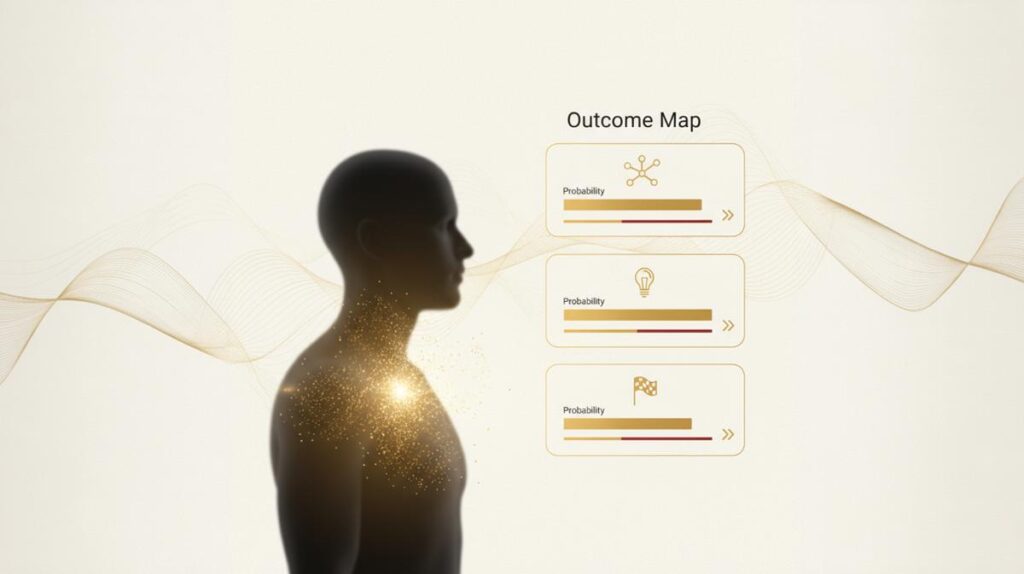
Write down 2–3 realistic scenarios. Describe near-term effects (1–3 months) and downstream effects (6–18 months). You don’t need perfect predictions — just plausible futures you can compare.
Prompt:
- If I choose A, what happens next month? What becomes easier? What becomes harder?
- If I choose B, what does my day look like in 90 days?
2) Weigh probabilities and trade-offs
Estimate what’s likely to happen given your context. Don’t chase certainty; chase clarity. A rough probability (e.g., “A has higher short-term stability; B has higher 12-month upside”) is enough to guide action.
Look for: effort required, time to benefit, risks, reversible vs. irreversible moves, and optionality you gain or lose.
3) Align with purpose and constraints
Ask: Which path better supports who I’m becoming? Purpose breaks ties when logic is close. Also check constraints (time, cash, health, relationships). A purpose-aligned decision that ignores constraints is fragile.
4) Choose deliberately (and define the next step)
Pick the best path for now and make it concrete: one next step you can complete in 24–72 hours. Momentum beats perfection.
Example next steps:
- Message three people who already took path B.
- Run a two-week test before committing fully.
- Block two hours for deep work on the chosen path.
A 2-minute exercise to escape autopilot
Set a timer for 2 minutes and do this on paper:
- Name the decision: one short sentence.
- List two outcomes: A and B (or A/B/C).
- Circle the outcome that is more reversible (easier to undo).
- Write one next step you can do this week.
When the timer ends, start the step. You just chose consciously.
Common traps (and how to fix them)
- Endless research: set a decision deadline and a max evidence budget (e.g., 48 hours, 5 sources).
- Perfectionism: shift the goal from perfect choice to best next step.
- Fear of regret: decide how you’ll measure learning, not just outcomes.
- Too many options: cut to two serious contenders and one wildcard.
- Outsourced choices: notice when you’re letting algorithms or social pressure decide.
When data meets intuition (and quantum thinking)
Conscious decision making isn’t cold calculation. It’s where intention meets probability. At QDEC we talk about quantum-inspired thinking: before you choose, there are many plausible futures; when you choose, you collapse one into reality. We don’t predict your destiny — we help you see possibilities clearly so you can take control.
Start today
Pick one real decision and run the QDEC method:
- Visualize two or three outcomes.
- Weigh the likely path and trade-offs.
- Align with purpose and constraints.
- Choose and act on the next step.
Do you live… or just exist? If you’re ready to take control, follow our updates as we roll out QDEC Alpha and expand the Quantum Decision Engine™.